
For couples and families
One set of books the whole household can read.
Maybe it’s a joint account beside two separate ones, a home loan, the kids’ costs, and money that goes back and forth between you. cent4cent keeps one set of books for all of it, so you both see the same numbers and know where the family stands.

What makes shared money hard to see.
- Three accounts, two apps, and no single number for where the family stands.
- Each of you has a different idea of what was spent this month, and nobody can check.
- Paying each other back gets filed as income, and nobody remembers who paid for the flights.
Three accounts, one picture of the household.
A joint account and one each, read together, so you both see the same month.
September, across the household
| Account | Who | Balance |
|---|---|---|
| Joint everyday | Both of you | 6,200.00 |
| Joint savings | Both of you | 18,500.00 |
| Everyday | Alex | 1,845.30 |
| Everyday | Jordan | 2,390.75 |
| Cash, all accounts | 28,936.05 | |
- Groceries came out of all three everyday accounts. Together they were A$1,184.60, about the same as usual.
- The A$600 Jordan moved to the joint account is a transfer, not income.
- You put away 22% of what came in, your best month since June.
A made-up household, for the example.
What the household gets.
-
Every account in one picture.
The joint account and each of yours, read together, with the month in three numbers you both trust.
-
One book, or one each and a joint one.
Invite your partner as a viewer or an editor. Keep a joint book together and your own on the side, and give your accountant read-only access when you need to.
-
Money back and forth, kept straight.
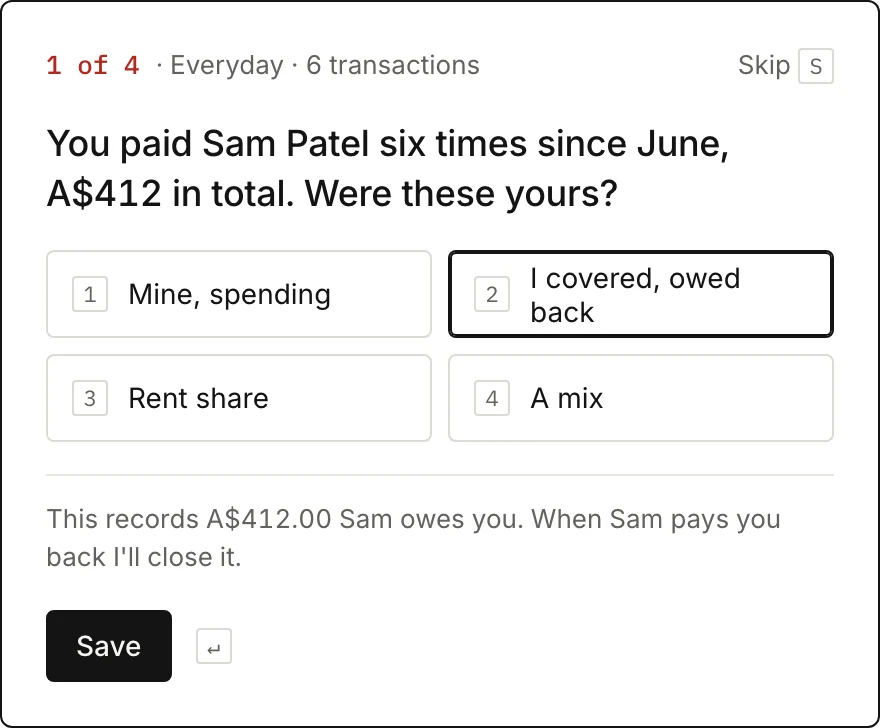
Moving money between your own accounts is never counted as spending or income, and a friend who owes you stays on the books until they pay you back.
Sharing a book.
Can we both use it on one subscription?
Yes. Invite your partner to a book as an editor or a viewer. It’s part of the plan, and so is giving your accountant read-only access.
Do we have to put everything in one book?
No. Keep a joint book together and your own books on the side, or one book for everything. Each person sees the books they’ve been invited to.
Set up the joint account first, and add your own after.
14 days free, no card needed. Then A$10 a month or A$100 a year, and your books are yours to export at any point.